
RESEARCH AREAS
Foundations of Complex Systems
Network Structure and Statistical Inference
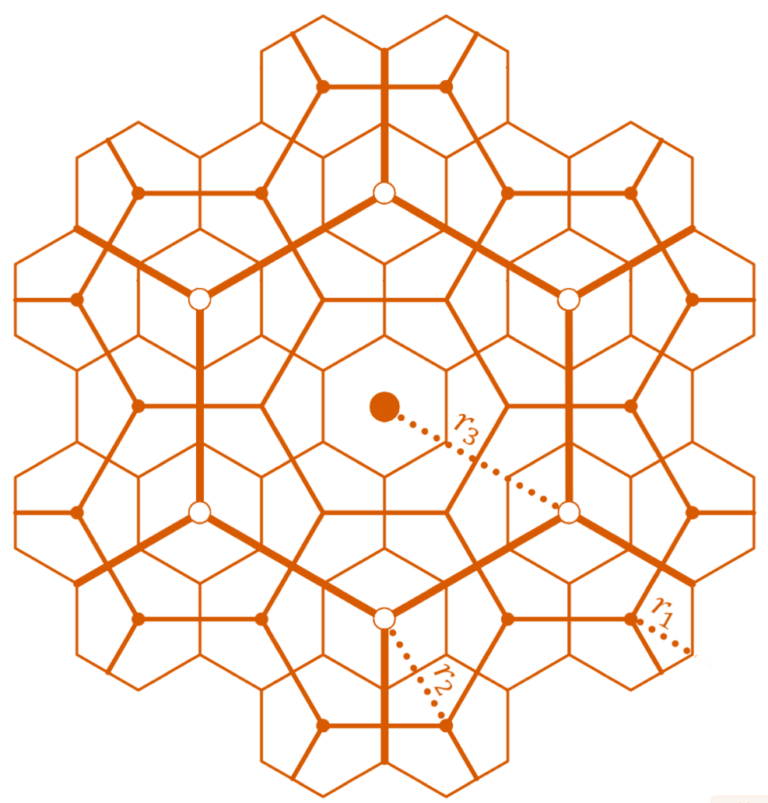
Complex networks exhibit a remarkable diversity of structural patterns, from modularity and nestedness to hybrid architectures combining different forms of organisation. Understanding how these patterns emerge, how they can be reliably identified, and how they influence collective dynamics is a fundamental challenge in complex systems science.
This research line focuses on developing mathematical and computational methods to characterise network organisation, with particular emphasis on bipartite networks and in-block nestedness, a mesoscale architecture combining modularity and nestedness.
Building on these contributions, we are extending our methodological framework towards statistical inference, seeking to identify and compare structural patterns through generative probabilistic models rather than relying exclusively on predefined structural descriptors.
Research focus
Hybrid structures in complex networks
Investigating the coexistence and interplay of different organisational patterns, particularly modularity, nestedness, and in-block nestedness. We study their mathematical properties, their relationships across organisational scales, and the conditions under which hybrid architectures emerge.
Detection and validation of structures
Developing methods to identify structural arrangements in empirical networks, assess their statistical significance, and evaluate the limitations of existing descriptors and null models. Particular attention is devoted to distinguishing genuine structural organisation from patterns arising through random fluctuations or network constraints.
Structural organisation and collective dynamics
Exploring how network architectures influence the dynamical behaviour of interacting systems, including their stability, robustness, and capacity to reorganise. Applications to ecological and socio-ecological networks provide a setting in which to investigate these relationships.
Bayesian inference of latent structures
Developing probabilistic approaches based on stochastic block models to infer nested, modular, and hybrid architectures directly from network observations. This ongoing research aims to compare alternative structural hypotheses through Bayesian model selection and minimum description length, providing a statistically grounded framework for network structure identification.